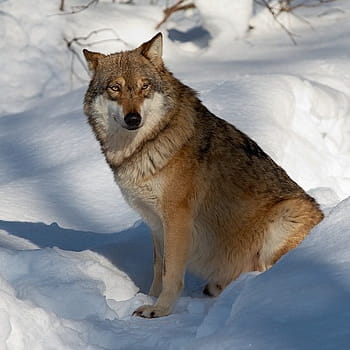
Sunday's wonderful winter weather, which, however, was only at higher altitudes thanks to the inversion, as if it called itself the creation of winter photos. The blue sky, lots of fresh snow and, compared to my previous visit to the Bavarian Forest National Park in autumn, plenty of large animals playing or just lounging lazily among the mounds of newly fallen powder, allowed me to take interesting and very nice pictures of large European mammals, which are difficult to find in the wild you will meet or vice versa, with whom a person would rather never meet face to face in nature. I mean mainly lynxes, wolves and bears. Especially thanks to the fact that we got to the enclosure of the wolves during their feeding time, we could observe the unusual life and very interesting behavior of a large wolf pack, especially the mutual respect and obedience of the other members to the dominant alpha pair, which stands at the head of the whole pack. However, the term alpha, which was coined to describe the behavior of animals living in captivity, is quite misleading. The alpha individual does not always lead the hunt or lead the pack, nor does he need to eat before the others. An individual can even be an alpha only under certain circumstances or during certain activities. But the alpha always enjoys the respect of the other members of the pack. The alpha pair is the only one in the pack that has the right to mate. The father of the young is usually the alpha male, but this may not always be the case. When the alpha shows no interest in the female, the lower ranked male will mate with her. However, the mother of the cubs is always the alpha female. In fact, the whole hierarchy is very important for wolves. It is of great importance during the breeding season, when hunting, when feeding, when protecting the territory and generally whenever the pack is together. Which means almost all the time, since the pack spends most of its time together. The wolf pack hierarchy is organized in two lines: one for males, the other for females. However, the hierarchy of such a pack can be very variable. The structure of the wolf pack is therefore very dynamic and can change depending on a number of factors.







 Germany
 Fauna and Flora